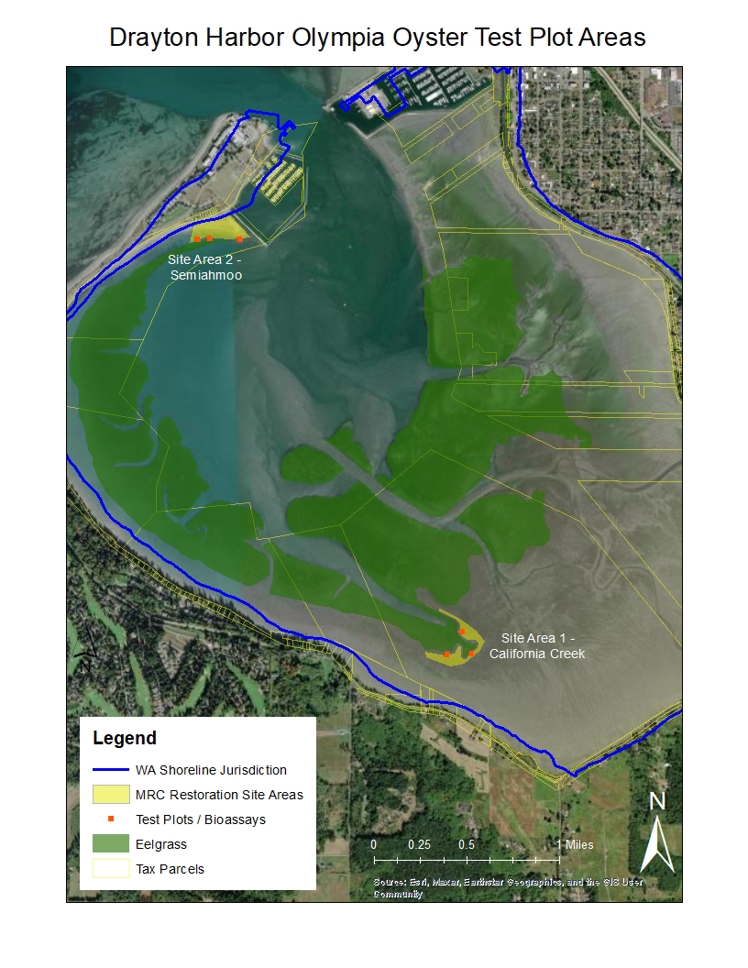
 Olympia oyster bioassay/test plot locations in Drayton Harbor.
Olympia Oyster Restoration
Olympia oysters play a crucial role in the ecosystem, providing habitat for other species, improving water quality, and supporting local food webs. However, natural populations of Olympia oysters have declined due to overharvesting, habitat loss, and pollution. The Washington Department of Fish and Wildlife conducted an extensive review of historical records to identify locations where large, natural Olympia oyster beds were present in the Puget Sound prior to exploitation, and identified Drayton Harbor and North Chuckanut Bay as promising locations for restoration efforts. The goal of this work is to establish self-sustaining populations of native Olympia oysters, exceeding 2 million individuals, in each location.
To read more about native Olympia oyster restoration projects along the West Coast, visit the Native Olympia Oyster Collaborative website.

MRC project lead, Jackie Dexter, and Puget Sound Restoration Fund staff, Brian Allen, examine Olympia oysters in Drayton Harbor. Photo credit: Allie Simpson.

Adult Olympia oyster. Photo credit: Dana Daniels.

Students with the Bellingham Technical College Fisheries and Aquaculture program help conduct an annual Olympia oyster population survey in North Chuckanut Bay. Photo credit: Dana Daniels.
Drayton Harbor
Allie Simpson
Olympia oyster bioassay/test plot locations in Drayton Harbor.
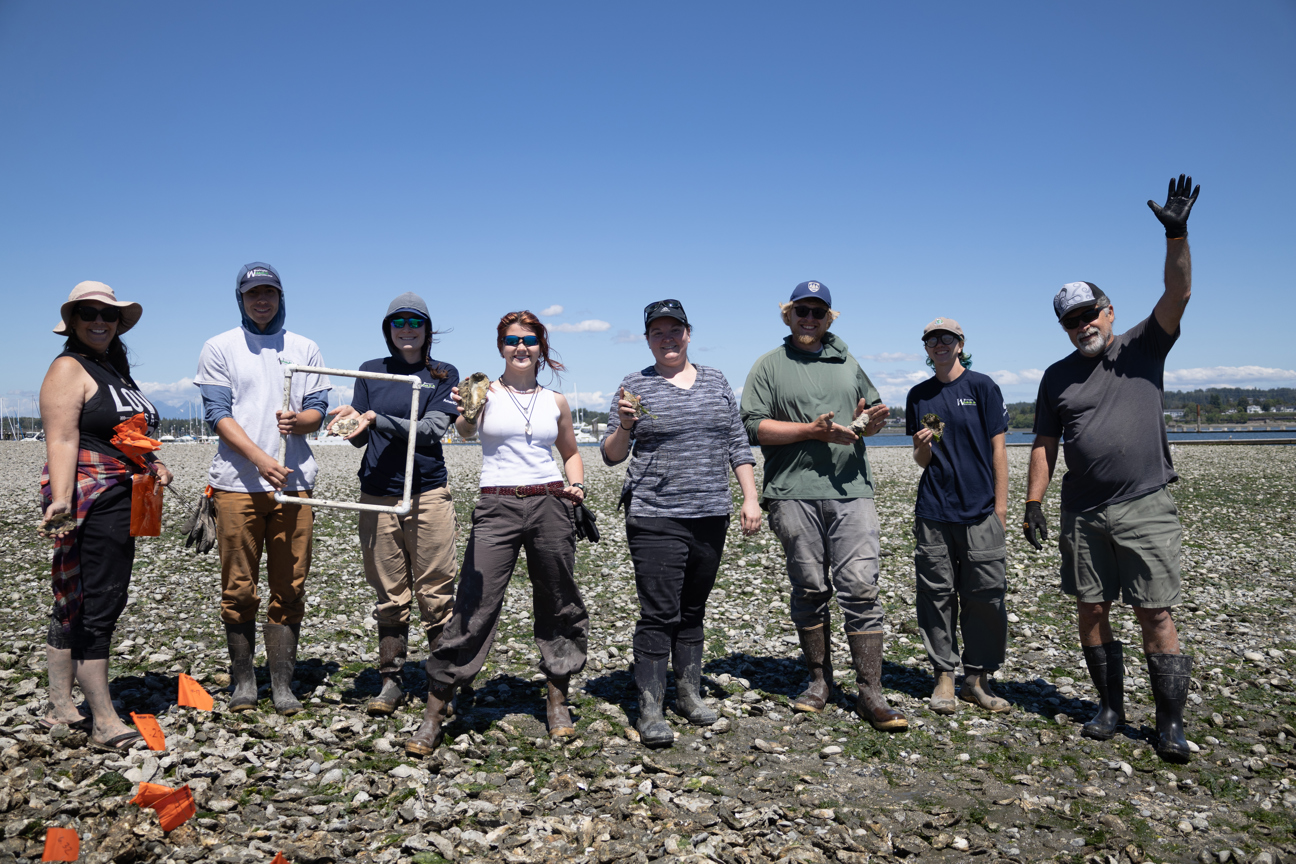
Volunteers establish Olympia oyster restoration test plots and conduct a population assessment at Drayton Harbor. Photo Credit: Alexi Guddal.
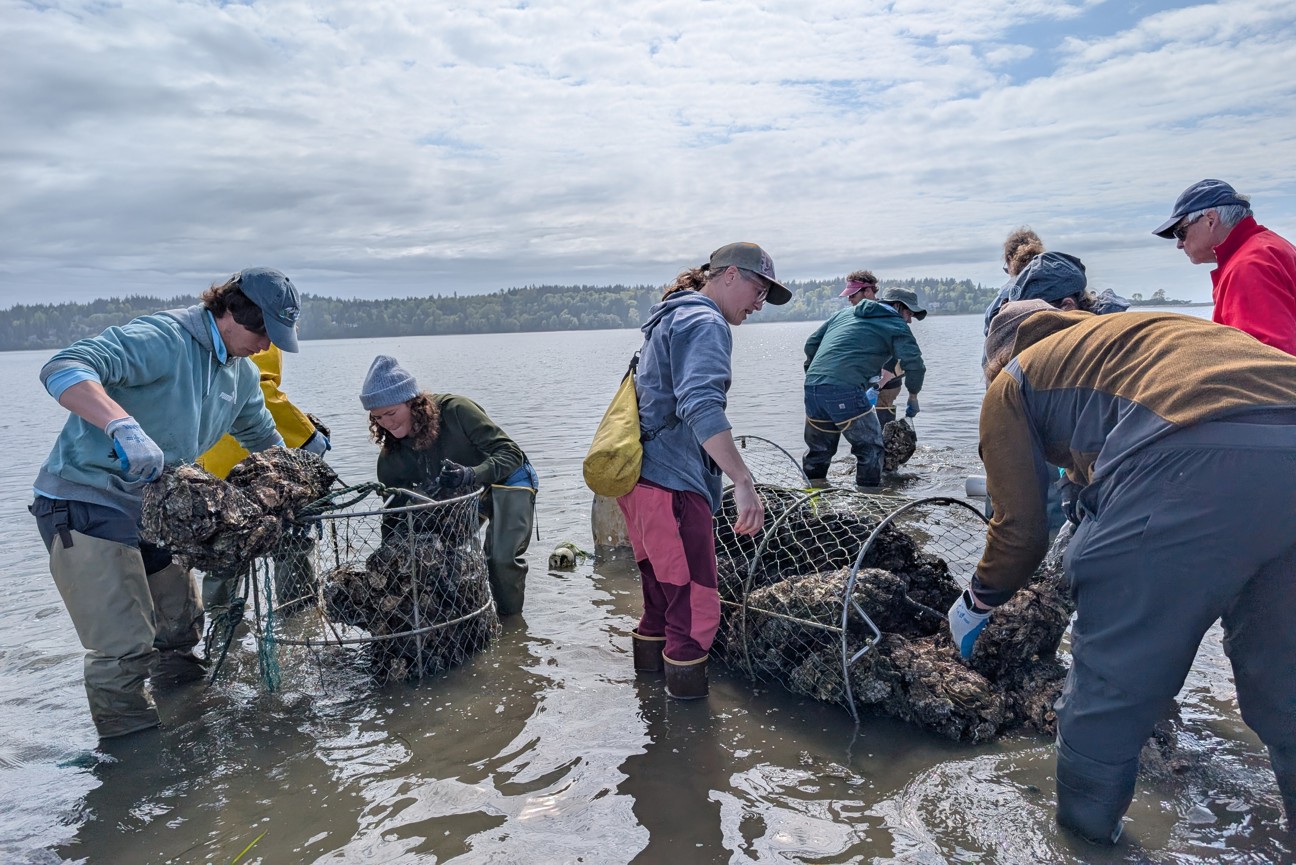
Volunteers and project partners set up a restoration test plot on Semiahmoo Spit. Photo credit: Dana Daniels.
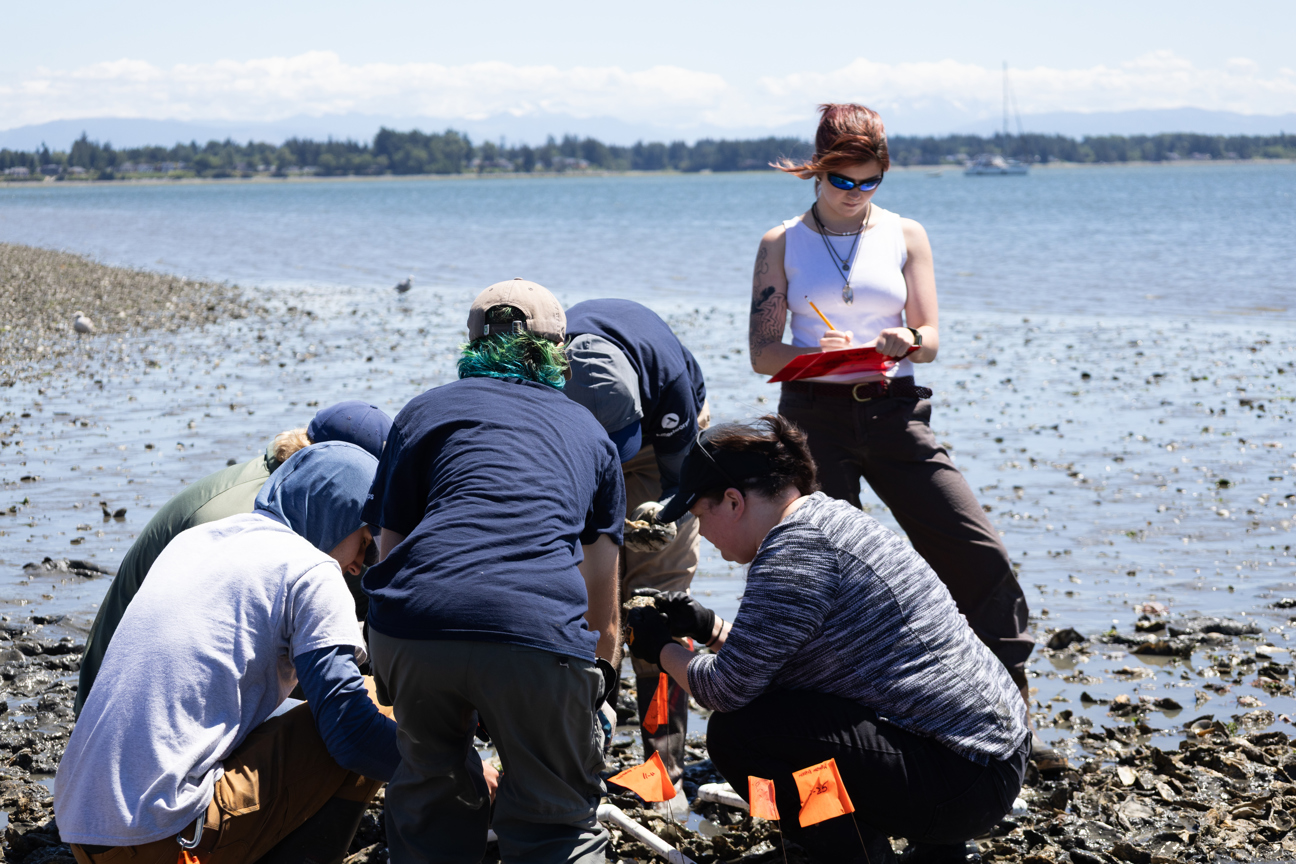
Volunteers collect baseline Olympia oyster population data at a test plot in Drayton Harbor. Photo credit: Alexi Guddal.
Check out the 2026 Drayton Harbor Olympia Oyster Report!
North Chuckanut Bay
Dana Daniels
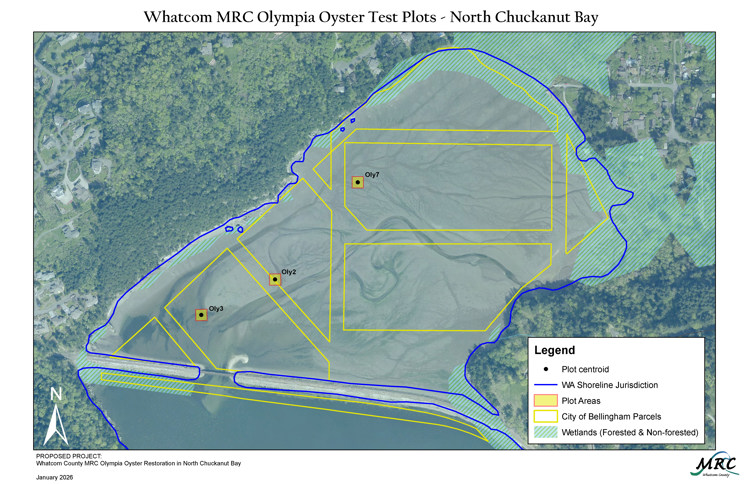 Olympia oyster test plots in North Chuckanut Bay.
In 2016, WDFW identified six plots within North Chuckanut Bay to pilot Olympia oyster restoration. In 2017, the MRC established six pilot restoration plots and one reference plot using 95,000 Olympia oyster spat on Pacific oyster shell. From 2018 to 2025, the MRC conducted annual population surveys of each of the test plots to assess restoration potential. Periodically, the substrate within the plots was enhanced with Pacific oyster shell. In 2025, WDFW conducted a site visit of the test plots with MRC staff and identified three that would be suitable for continued restoration efforts.
Building on these findings, the MRC partnered with PSRF and the Northwest Maritime Center in 2026 to expand restoration efforts. With the help of volunteers and project partners, a total of 200 bags of Olympia oyster spat were outplanted across the 3 restoration plots.
In 2027, the MRC will begin annual Olympia oyster population assessments to further investigate restoration potential at each site. These assessments may occur for up to five years and may inform future restoration actions at this site.